Package: simu5g.common.carrierAggregation
CarrierAggregation
compound moduleImplements the Carrier Aggregation (CA) functionality used at the Medium Access Control (MAC) layer of e/gNodeBs and UEs. CA allows multiple frequency bands - referred to as Component Carriers (CCs) - to be aggregated in order to increase the overall available bandwidth of the system. Each CC is implemented as a submodule and can be configured independently from each other. e/gNodeB and UE can be configured to use one or more CCs among those configured in this module. There must be one (and only one) instance of this module in the network.
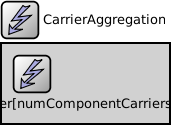
Usage diagram
The following diagram shows usage relationships between types. Unresolved types are missing from the diagram.
Used in
| Name | Type | Description |
|---|---|---|
| EthernetSessions | network |
A 5G standalone network whose UPF anchors Ethernet PDU sessions: its Ethernet N6 link goes to dnStation, a host of the data network's Ethernet LAN, and its IP N6 link to a router and a server, for the UEs of IP sessions. With hasSecondGnb, a second gNB (with an X2 link to the first) lets a UE hand over. device[] are the Ethernet devices behind ue[0], which is then an Ethernet bridge (see the ethernetMode parameter of LteUe). |
| ExtClientServer_bgCells | network |
ExtClientServerExample with background cells instead of external ones: one gNodeB served by a Upf core, a router in front of the Upf, one NrUe, and numBgCells BackgroundCell cells. The router has no simulated peer: the host it talks to, and the applications on the NrUe, are configured in the ini file. |
| ExtClientServerExample | network |
One gNodeB served by a Upf core, a router in front of the Upf, and one NrUe. numExtCells ExtCell cells can be added as interferers. The router has no simulated peer: the host it talks to, and the applications on the NrUe, are configured in the ini file. |
| ExtMecAppExample | network |
One gNodeB and one MecHost hung off the same intermediate Upf, behind an anchor Upf that carries the Ualcmp and, behind it, the MecOrchestrator, plus one NrUe. Nothing here is external: which node talks to a real host, and over which interface, is configured in the ini file. |
| ExtServerExample | network |
One gNodeB served by a Upf core, a router in front of the Upf, and two NrUe terminals. numExtCells ExtCell cells can be added as interferers. The router has no simulated peer: the host it talks to, and the applications on the UEs, are configured in the ini file. |
| ExtUeAppExample | network |
One gNodeB and one MecHost hung off the same intermediate Upf, behind an anchor Upf that carries the Ualcmp and, behind it, the MecOrchestrator, plus one NrUe. Nothing here is external: which node talks to a real host, and over which interface, is configured in the ini file. |
| ExtUeAppMecAppExample | network |
One gNodeB and one MecHost hung off the same intermediate Upf, behind an anchor Upf that carries the Ualcmp and, behind it, the MecOrchestrator, plus one NrUe. Nothing here is external: which node talks to a real host, and over which interface, is configured in the ini file. |
| MultiCell | network |
Two eNodeB cells on a shared EPC PgwStandard, joined by an X2 link, with a router and a server behind the core. Four LteUe terminals are placed two per cell, and numExtCells ExtCell cells can be added as interferers. With hasD2D, the network holds the D2dBinder that D2D-capable nodes need, so that '**.hasD2D = true' turns D2D on in the network and in all its nodes. |
| MultiCell_D2DMultihop | network |
Five eNodeB cells, each reaching the EPC PgwStandard through a router of its own, with a further router and a server behind the core. There are no X2 links. numUe1 to numUe5 LteUe terminals attach per cell, and an EventGenerator and a MultihopD2DStatistics module sit beside them, wired to nothing. |
| MultiCell_Standalone | network |
Two gNodeB cells served by a 5G core: the anchor Upf faces the data network (a router and a server), an intermediate Upf feeds both gNodeBs, and an X2 link joins them. numUe NrUe terminals attach, and numBgCells BackgroundCell cells can be added as interferers. |
| MultiCell_withSecondaryGnb | network |
The two-cell version of SingleCell_withSecondaryGnb: two eNodeB masters, each paired over X2 with its own gNodeB secondary, and a further X2 link between the two masters. Both eNodeBs connect to the EPC PgwStandard, which faces a router and a server; neither gNodeB has a core-network link. numUe NrUe terminals attach, and numBgCells BackgroundCell cells can be added as interferers. |
| MultiCell_X2Mesh | network |
Three eNodeB cells in a full X2 mesh. Each reaches the EPC PgwStandard through a router of its own, and the server sits directly on the PgwStandard's data-network gate. numUe1, numUe2 and numUe3 LteUe terminals attach per cell, and numExtCells ExtCell cells can be added as interferers. |
| MultiMecHost | network |
Two gNodeB cells, each on an intermediate Upf of its own with a MecHost hung off it, so every cell has its own MEC host. Both intermediate Upf nodes meet at the anchor Upf, which carries the Ualcmp and, behind it, the MecOrchestrator. An X2 link joins the two gNodeBs. numUe NrUe terminals attach, and numBgCells BackgroundCell cells can be added as interferers. |
| MultiMecHost_delay | network |
MultiMecHost with the two intermediate Upf nodes linked directly to each other, and with no X2 link between the gNodeBs. The length of that link -- and so its propagation delay -- follows the routersDelay parameter, which makes the distance between the two MEC hosts configurable. |
| MultiOperator | network |
Two operator networks side by side. Each has three gNodeB cells chained by X2, an intermediate Upf that feeds them and carries the operator's MecHost, an anchor Upf, and a Ualcmp with its MecOrchestrator. The two anchor Upf nodes meet at a shared router, the only node the operators have in common. numUe_A and numUe_B NrUe terminals attach to operator A and B respectively, and numBgCells BackgroundCell cells can be added as interferers. |
| RnisTest | network |
The topology of SingleMecHost -- one gNodeB and one MecHost on a shared intermediate Upf, with a Ualcmp and a MecOrchestrator behind the anchor Upf -- without its playground size parameters. numUes NrUe terminals attach to the gNodeB. |
| SingleCell | network |
The minimal LTE topology: one eNodeB connected to an EPC PgwStandard, which faces a router and a server, plus numUe LteUe terminals. |
| SingleCell_D2D | network |
SingleCell with its UEs split into three vectors, so that a configuration can address cellular terminals (ueCell), D2D transmitters (ueD2DTx) and D2D receivers (ueD2DRx) separately. The rest of the topology is the same: one eNodeB on an EPC PgwStandard, with a router and a server behind it. |
| SingleCell_D2DMulticast | network |
SingleCell with its UEs split into cellular terminals (ueCell) and members of a D2D multicast group (ueD2D). The rest of the topology is the same: one eNodeB on an EPC PgwStandard, with a router and a server behind it. |
| SingleCell_Standalone | network |
One gNodeB served by a 5G core: the anchor Upf faces the data network (a router and a server), and an intermediate Upf sits between it and the gNodeB. numUe NrUe terminals attach to the gNodeB, and numBgCells BackgroundCell cells can be added around it as interferers. |
| SingleCell_Standalone_D2D | network |
SingleCell_Standalone with its UEs split into three vectors, so that a configuration can address cellular terminals (ueCell), D2D transmitters (ueD2DTx) and D2D receivers (ueD2DRx) separately. The rest of the topology is the same: one gNodeB behind an intermediate and an anchor Upf, with a router and a server on the data network, plus numBgCells BackgroundCell interferers. |
| SingleCell_withSecondaryEnb | network |
The mirror image of SingleCell_withSecondaryGnb: here the gNodeB is the master node and the eNodeB is its secondary, so the UE is anchored on its NR stack and its LTE stack carries the secondary cell group. All data-plane traffic enters at the gNodeB. |
| SingleCell_withSecondaryGnb | network |
An EN-DC topology: an eNodeB master paired over X2 with a gNodeB secondary. The eNodeB is the only node with a core-network link -- an EPC PgwStandard facing a router and a server -- so all data-plane traffic enters there, and the gNodeB contributes its radio leg alone. numUe NrUe terminals attach to both, and numBgCells BackgroundCell cells can be added as interferers. |
| SingleMecHost | network |
One gNodeB and one MecHost hung off the same intermediate Upf, behind an anchor Upf that carries the Ualcmp and, behind it, the MecOrchestrator. numUes NrUe terminals attach to the gNodeB. |
| UrbanNetwork | network | (no description) |
Parameters
| Name | Type | Default value | Description |
|---|---|---|---|
| numComponentCarriers | int | 1 |
Properties
| Name | Value | Description |
|---|---|---|
| display | i=block/control |
Unassigned submodule parameters
| Name | Type | Default value | Description |
|---|---|---|---|
| componentCarrier.binderModule | string | "binder" | |
| componentCarrier.carrierFrequency | double | 2GHz |
Carrier Frequency (GHz) |
| componentCarrier.numBands | int | 6 |
Number of bands for this channel |
| componentCarrier.numerologyIndex | int | 0 |
Numerology index |
| componentCarrier.useTdd | bool | false | |
| componentCarrier.tddNumSymbolsDl | int | 7 | |
| componentCarrier.tddNumSymbolsUl | int | 7 |
Source code
//
// Implements the Carrier Aggregation (CA) functionality used at the
// Medium Access Control (MAC) layer of e/gNodeBs and UEs. CA allows multiple frequency bands -
// referred to as Component Carriers (CCs) - to be aggregated in order to increase the overall
// available bandwidth of the system. Each CC is implemented as a submodule and can be
// configured independently from each other. e/gNodeB and UE can be configured to use
// one or more CCs among those configured in this module.
// There must be one (and only one) instance of this module in the network.
//
module CarrierAggregation
{
    parameters:
        @display("i=block/control");
        int numComponentCarriers = default(1);

    submodules:
        componentCarrier[numComponentCarriers]: ComponentCarrier;
}
File: src/simu5g/common/carrierAggregation/CarrierAggregation.ned
 This documentation is released under the Creative Commons license