Package: simu5g.corenetwork.ethernetSessionBridge
EthernetSessionBridge
compound moduleThe Ethernet bridge of a Upf, which forwards the traffic of its Ethernet PDU sessions "based on detected MAC addresses" (TS 23.501 5.8.2.5.3): one learning bridge per UPF, whose ports are the Ethernet sessions the UPF anchors and one N6 Ethernet interface, the node's dnEth (TS 23.501 5.8.2.5.3, NOTE 2), which is connected to lowerLayerIn/Out: a submodule of the node, but a port of this bridge, registered in its interface table. A session's uplink frames enter the bridge on the session's port; the bridge learns their source addresses, forwards known unicast to the port of the destination (another session: switched locally, not via N6; or dnEth), floods unknown unicast, broadcast and multicast to every port but the ingress, and drops a frame whose destination is on its ingress port. Learning is per VLAN.
The bridge is INET's layered BridgingLayer over its own interface table and MAC table, so the session ports and dnEth get no IP configuration and no routes, and the bridge floods among them only. A session port (EthernetSessionPort) is created when the session is established at the UPF and deleted when it is released, its MAC table entries flushed first; EthernetSessionMux does both, on the calls of the node's UserPlaneNodeControl, and connects the ports' lower sides to the node's GTP-U path: uplink frames from GtpUser, downlink frames to the TrafficFlowFilter, each tagged with its session (SessionTag).
The frames carry their FCS inside the bridge; GtpUser rebuilds it where a frame leaves the tunnel and strips it where one enters, after the traffic flow filter has classified the full frame (TS 23.501 5.6.10.2: the 5GS does not carry the FCS).
Not modeled (TS 23.501 5.8.2.5.3): flooding scoped to a VLAN (frames are flooded across VLANs), ARP/ND proxying, allowed VLAN/MAC lists, S-/C-TAG handling, the reporting of learned MAC addresses to the SMF, PSA relocation, 5G VN groups.
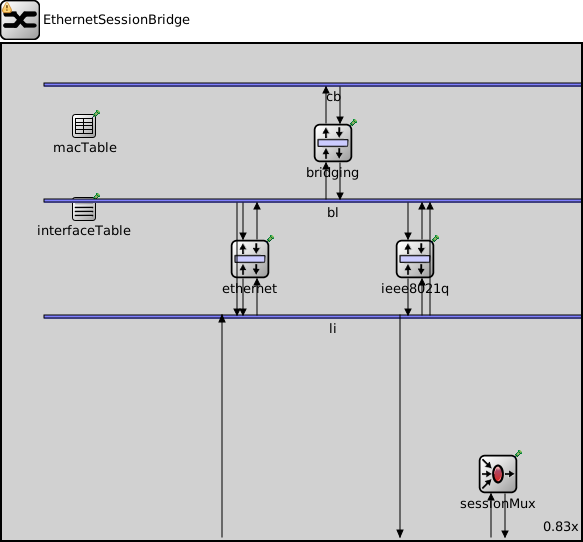
Usage diagram
The following diagram shows usage relationships between types. Unresolved types are missing from the diagram.
Used in compound modules
| Name | Type | Description |
|---|---|---|
| Upf | compound module |
Implements the 5G Core User Plane Function (UPF). |
Properties
| Name | Value | Description |
|---|---|---|
| display | i=block/switch;bgb=700,600 |
Gates
| Name | Direction | Size | Description |
|---|---|---|---|
| sessionIn | input |
uplink frames of the sessions, from GtpUser (the ethernetmac service, which the session mux registers) |
|
| sessionOut | output |
downlink frames of the sessions, to the TrafficFlowFilter |
|
| lowerLayerOut | output |
to the N6 Ethernet interface (the node's dnEth) |
|
| lowerLayerIn | input |
from the N6 Ethernet interface |
Unassigned submodule parameters
| Name | Type | Default value | Description |
|---|---|---|---|
| macTable.agingTime | double | ||
| macTable.forwardingTableFile | string | ||
| interfaceTable.displayStringTextFormat | string | "{numInterfaces} interfaces" |
Determines the text that is written on top of the submodule, supports displaying pars, watches, and module-specific information |
| interfaceTable.displayAddresses | bool | false |
Whether to display IP addresses on links |
| sessionMux.interfaceTableModule | string |
The bridge's interface table, which the session ports are registered in |
|
| sessionMux.macTableModule | string |
The bridge's MAC table, flushed of a released session's port |
|
| sessionMux.portModuleType | string | "simu5g.corenetwork.ethernetSessionBridge.EthernetSessionPort" |
The module type of the session ports |
| sessionMux.portDisplayString | string | "p=500,420,row,100;g=sessionPorts" |
Display string of the session ports (their place in the bridge's layout) |
| cb.displayStringTextFormat | string | "processed {numProcessedPackets} pk ({processedTotalLength})" |
Determines the text that is written on top of the submodule, supports displaying pars, watches, and module-specific information |
| cb.interfaceTableModule | string |
Module path to the InterfaceTable module |
|
| cb.forwardServiceRegistration | bool | true | |
| cb.forwardProtocolRegistration | bool | true | |
| cb.interfaceMapping | object | {} |
Maps network interface names to connected submodule names (e.g. {"eth0": "bridging"}), overrides automatically learned dispatching; * overrides all learned network interfaces, ? overrides default |
| cb.serviceMapping | object | {} |
Maps protocols to connected submodule names (e.g. {"ethernetmac": "bridging"}), overrides automatically learned dispatching; * overrides all learned services, ? overrides default |
| cb.protocolMapping | object | {} |
Maps protocols to connected submodule names (e.g. {"ipv4": "bridging"}), overrides automatically learned dispatching; * overrides all learned protocols, ? overrides default |
| bl.displayStringTextFormat | string | "processed {numProcessedPackets} pk ({processedTotalLength})" |
Determines the text that is written on top of the submodule, supports displaying pars, watches, and module-specific information |
| bl.interfaceTableModule | string |
Module path to the InterfaceTable module |
|
| bl.forwardServiceRegistration | bool | true | |
| bl.forwardProtocolRegistration | bool | true | |
| bl.interfaceMapping | object | {} |
Maps network interface names to connected submodule names (e.g. {"eth0": "bridging"}), overrides automatically learned dispatching; * overrides all learned network interfaces, ? overrides default |
| bl.serviceMapping | object | {} |
Maps protocols to connected submodule names (e.g. {"ethernetmac": "bridging"}), overrides automatically learned dispatching; * overrides all learned services, ? overrides default |
| bl.protocolMapping | object | {} |
Maps protocols to connected submodule names (e.g. {"ipv4": "bridging"}), overrides automatically learned dispatching; * overrides all learned protocols, ? overrides default |
| li.displayStringTextFormat | string | "processed {numProcessedPackets} pk ({processedTotalLength})" |
Determines the text that is written on top of the submodule, supports displaying pars, watches, and module-specific information |
| li.interfaceTableModule | string |
Module path to the InterfaceTable module |
|
| li.forwardServiceRegistration | bool | true | |
| li.forwardProtocolRegistration | bool | true | |
| li.interfaceMapping | object | {} |
Maps network interface names to connected submodule names (e.g. {"eth0": "bridging"}), overrides automatically learned dispatching; * overrides all learned network interfaces, ? overrides default |
| li.serviceMapping | object | {} |
Maps protocols to connected submodule names (e.g. {"ethernetmac": "bridging"}), overrides automatically learned dispatching; * overrides all learned services, ? overrides default |
| li.protocolMapping | object | {} |
Maps protocols to connected submodule names (e.g. {"ipv4": "bridging"}), overrides automatically learned dispatching; * overrides all learned protocols, ? overrides default |
Source code
//
// The Ethernet bridge of a ~Upf, which forwards the traffic of its Ethernet PDU sessions
// "based on detected MAC addresses" (TS 23.501 5.8.2.5.3): one learning bridge per UPF,
// whose ports are the Ethernet sessions the UPF anchors and one N6 Ethernet interface,
// the node's dnEth (TS 23.501 5.8.2.5.3, NOTE 2), which is connected to lowerLayerIn/Out:
// a submodule of the node, but a port of this bridge, registered in its interface table. A session's uplink frames enter the bridge on the
// session's port; the bridge learns their source addresses, forwards known unicast to
// the port of the destination (another session: switched locally, not via N6; or dnEth),
// floods unknown unicast, broadcast and multicast to every port but the ingress, and
// drops a frame whose destination is on its ingress port. Learning is per VLAN.
//
// The bridge is INET's layered BridgingLayer over its own interface table and
// MAC table, so the session ports and dnEth get no IP configuration and no routes, and
// the bridge floods among them only. A session port (~EthernetSessionPort) is created
// when the session is established at the UPF and deleted when it is released, its MAC
// table entries flushed first; ~EthernetSessionMux does both, on the calls of the node's
// ~UserPlaneNodeControl, and connects the ports' lower sides to the node's GTP-U path:
// uplink frames from ~GtpUser, downlink frames to the ~TrafficFlowFilter, each tagged
// with its session (~SessionTag).
//
// The frames carry their FCS inside the bridge; ~GtpUser rebuilds it where a frame leaves
// the tunnel and strips it where one enters, after the traffic flow filter has classified
// the full frame (TS 23.501 5.6.10.2: the 5GS does not carry the FCS).
//
// Not modeled (TS 23.501 5.8.2.5.3): flooding scoped to a VLAN (frames are flooded across
// VLANs), ARP/ND proxying, allowed VLAN/MAC lists, S-/C-TAG handling, the reporting of
// learned MAC addresses to the SMF, PSA relocation, 5G VN groups.
//
module EthernetSessionBridge
{
    parameters:
        @display("i=block/switch;bgb=700,600");
        **.interfaceTableModule = default(absPath(".interfaceTable"));
        **.macTableModule = default(absPath(".macTable"));
        *.fcsMode = "declared";
        ethernet.*.promiscuous = true;
        ethernet.registerProtocol = true;
    gates:
        input sessionIn;       // uplink frames of the sessions, from ~GtpUser (the ethernetmac service, which the session mux registers)
        output sessionOut;     // downlink frames of the sessions, to the ~TrafficFlowFilter
        output lowerLayerOut;  // to the N6 Ethernet interface (the node's dnEth)
        input lowerLayerIn;    // from the N6 Ethernet interface
    submodules:
        macTable: <default("MacForwardingTable")> like IMacForwardingTable {
            @display("p=100,100;is=s");
        }
        interfaceTable: InterfaceTable {
            @display("p=100,200;is=s");
        }
        sessionMux: EthernetSessionMux {
            portDisplayString = default("p=500,420,row,100;g=sessionPorts");
            @display("p=600,520");
        }
        cb: MessageDispatcher {
            @display("p=400,50;b=700,5,,,,1");
        }
        bridging: <default("BridgingLayer")> like IProtocolLayer {
            @display("p=400,120");
        }
        bl: MessageDispatcher {
            @display("p=400,190;b=700,5,,,,1");
        }
        ethernet: <default("EthernetLayer")> like IEthernetLayer {
            @display("p=300,260");
        }
        ieee8021q: <default("Ieee8021qProtocol")> like IIeee8021qLayer {
            @display("p=500,260");
        }
        li: MessageDispatcher {
            @display("p=400,330;b=700,5,,,,1");
        }
    connections allowunconnected:
        cb.out++ --> bridging.upperLayerIn;
        bridging.upperLayerOut --> cb.in++;
        bridging.lowerLayerOut --> bl.in++;
        bl.out++ --> bridging.lowerLayerIn;
        bl.out++ --> ethernet.upperLayerIn;
        ethernet.upperLayerOut --> bl.in++;
        bl.out++ --> ieee8021q.upperLayerIn;
        ieee8021q.upperLayerOut --> bl.in++;
        bl.out++ --> li.in++;
        li.out++ --> bl.in++;
        ethernet.lowerLayerOut --> li.in++;
        li.out++ --> ethernet.lowerLayerIn;
        ieee8021q.lowerLayerOut --> li.in++;
        li.out++ --> ieee8021q.lowerLayerIn;
        li.out++ --> { @display("m=s"); } --> lowerLayerOut;
        lowerLayerIn --> { @display("m=s"); } --> li.in++;
        sessionIn --> sessionMux.sessionIn;
        sessionMux.sessionOut --> sessionOut;
}
File: src/simu5g/corenetwork/ethernetSessionBridge/EthernetSessionBridge.ned
 This documentation is released under the Creative Commons license