Package: simu5g.stack
LteNicEnb
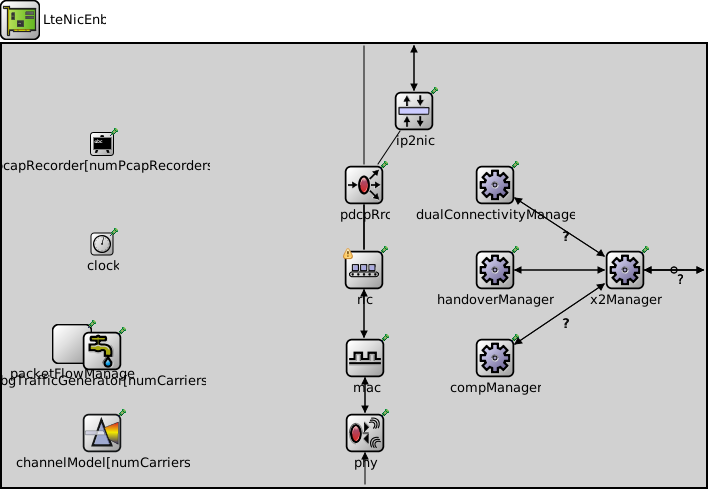
compound moduleThe LteNicEnb module is a network interface that provides LTE connectivity within an eNodeB. It implements the data and signaling planes of the LTE stack, which includes the PDCP, RLC, MAC, and PHY layers. The parameters and submodules allow customization of the eNodeB's behavior, including whether it supports D2D communication, CoMP (Coordinated MultiPoint), or dual connectivity.
The PDCP and RLC entities are missing from the submodules on purpose: the RRC layer's BearerManagement creates them per bearer at run time.
Usage diagram
The following diagram shows usage relationships between types. Unresolved types are missing from the diagram.
Inheritance diagram
The following diagram shows inheritance relationships for this type. Unresolved types are missing from the diagram.
Known subclasses
| Name | Type | Description |
|---|---|---|
| LteNicEnbD2D | compound module |
The LteNicEnbD2D module represents an LTE eNodeB network interface with support for D2D (Device-to-Device) communications. It extends the basic LteNicEnb module to manage D2D-capable UEs (User Equipments). A D2D mode selection algorithm can be specified via the rrc.d2dModeSelection submodule's typename. |
| NrNicEnb | compound module |
The NrNicEnb module serves as a network interface that provides 5G connectivity within a gNodeB. It implements the data and signaling plane of the NR (New Radio) stack, which encompasses the PDCP, RLC, MAC, and PHY layers. The parameters and submodules facilitate the customization of the gNodeB's behavior, including its support for CoMP (Coordinated MultiPoint) or dual connectivity. D2D support is added by the NrNicEnbD2D subtype. |
Extends
| Name | Type | Description |
|---|---|---|
| LteNicBase | compound module |
The LteNicBase module serves as the foundational building block for LTE networking in Simu5G. It integrates protocols for LTE communication, including PDCP, RLC, MAC, and PHY layers. This base module allows higher-level modules, such as User Equipment (UE) and eNodeB (evolved Node B), to configure and utilize these layers according to their specific requirements. |
Parameters
| Name | Type | Default value | Description |
|---|---|---|---|
| displayStringTextFormat | string | "%a (%i)\n%m" |
Determines the text that is written on top of the submodule, supports displaying pars, watches, and module-specific information |
| recordPcap | bool | false | |
| numPcapRecorders | int | recordPcap ? 1 : 0 | |
| isWireless | bool | true | |
| interfaceTableModule | string | ||
| routingTableModule | string | ||
| hasRniSupport | bool | false | |
| nodeType | string | ||
| processingDelayIn | double | 0s |
Additional processing delay for incoming ip packets |
| processingDelayOut | double | 0s |
Additional processing delay for outgoing ip packets |
| channelModelType | string | "StochasticChannelModel" | |
| dualConnectivityEnabled | bool | false | |
| numCarriers | int | 1 | |
| address | string | "auto" | |
| compEnabled | bool | false |
Properties
| Name | Value | Description |
|---|---|---|
| class | NonlayoutingNetworkInterface | |
| networkInterface | ||
| lifecycleSupport | ||
| display | i=block/ifcard;bgb=800,810;bgl=3 |
Gates
| Name | Direction | Size | Description |
|---|---|---|---|
| upperLayerIn | input | ||
| upperLayerOut | output | ||
| radioIn | input |
To receive messages sent using sendDirect() |
|
| nrRadioIn | input |
For NR support |
|
| x2 [ ] | inout |
Optional X2 manager |
Signals
| Name | Type | Unit | Description |
|---|---|---|---|
| packetDropped | inet::Packet |
Statistics
| Name | Title | Source | Record | Unit | Interpolation Mode | Description |
|---|---|---|---|---|---|---|
| packetDropInterfaceDown | packet drops: interface down | packetDropReasonIsInterfaceDown(packetDropped) | count, sum(packetBytes), vector(packetBytes) | none | ||
| packetDropNoCarrier | packet drops: no carrier | packetDropReasonIsNoCarrier(packetDropped) | count, sum(packetBytes), vector(packetBytes) | none |
Unassigned submodule parameters
| Name | Type | Default value | Description |
|---|---|---|---|
| pcapRecorder.displayStringTextFormat | string | "rec: %n pks" |
Determines the text that is written on top of the submodule, supports displaying pars, watches, and module-specific information |
| pcapRecorder.verbose | bool | true |
Whether to log packets on the module output |
| pcapRecorder.recordEmptyPackets | bool | true |
Specifies if zero length packets are recorded or not |
| pcapRecorder.enableConvertingPackets | bool | true |
Specifies if converting packets to link type is allowed or not |
| pcapRecorder.pcapFile | string | "" |
The PCAP file to be written, suggested value: pcapFile = "${resultdir}/${configname}-#${runnumber}" + fullpath() + ".pcap" |
| pcapRecorder.fileFormat | string | "pcapng" | |
| pcapRecorder.snaplen | int | 65535 |
Maximum number of bytes to record per packet |
| pcapRecorder.timePrecision | int | 6 |
Time precision in recorded file. pcap supports only 6 (usec) or 9 (nanosec), pcapng supports more values (see 'if_tsresol' option in pcapng file format). |
| pcapRecorder.dumpBadFrames | bool | true |
Enable dump of frames with hasBitError |
| pcapRecorder.sendingSignalNames | string | "transmissionEnded" |
Space-separated list of outbound packet signals to subscribe to |
| pcapRecorder.receivingSignalNames | string | "receptionEnded" |
Space-separated list of inbound packet signals to subscribe to |
| pcapRecorder.dumpProtocols | string | "ethernetmac ppp ieee80211mac" |
Space-separated list of protocol names as defined in the Protocol class |
| pcapRecorder.packetFilter | object | "*" |
Which packets are considered, matches all packets by default |
| pcapRecorder.helpers | string | "" |
Usable PcapRecorder::IHelper helpers for accept packettype and store/convert packet as specified linktype currently available: "inet::AckingMacToEthernetPcapRecorderHelper" |
| pcapRecorder.alwaysFlush | bool | false |
Flush the pcapFile after each write to ensure that all packets are captured in case of a crash |
| ip2nic.isNr | bool | ||
| rlcMux.bearerManagementModule | string | ||
| packetFlowObserver.macModule | string | ||
| packetFlowObserver.pdcpModule | string | ||
| packetFlowObserver.rlcModule | string | ||
| packetFlowObserver.isNrObserver | bool | ||
| packetFlowObserver.pfmType | string | ||
| pdcpDcMux.bearerManagementModule | string | "^.rrc.bearerManagement" | |
| x2Manager.interfaceTableModule | string | ||
| x2Manager.binderModule | string | "binder" | |
| handoverX2Forwarder.losslessHandover | bool | false |
Source code
//
// The LteNicEnb module is a network interface that provides LTE connectivity
// within an eNodeB. It implements the data and signaling planes of the LTE stack,
// which includes the PDCP, RLC, MAC, and PHY layers. The parameters and submodules
// allow customization of the eNodeB's behavior, including whether it supports
// D2D communication, CoMP (Coordinated MultiPoint), or dual connectivity.
//
// The PDCP and RLC entities are missing from the submodules on purpose: the RRC
// layer's ~BearerManagement creates them per bearer at run time.
//
module LteNicEnb extends LteNicBase
{
    parameters:
        mac.typename = default("LteMacEnb");
        phy.typename = default("PhyEnb");
        handoverPacketHolder.typename = default("HandoverPacketHolderEnb");
        packetFlowObserver.typename = default("PacketFlowObserverEnb");
        bool compEnabled = default(false);
        rrc.hasConnectionControl = true;
        rrc.connectionControl.macNodeId = parent.macNodeId;

    submodules:
        pdcpDcMux: DcMux {
            @display("p=609,340;is=s");
        }

        //#
        //# X2 manager
        //#
        x2Manager: LteX2Manager {
            @display("p=717,200;is=s");
        }

        //#
        //# Modules exploiting X2 interface
        //#
        compManager: <default("LteCompManagerProportional")> like ILteCompManager if compEnabled {
            @display("p=717,340;is=s");
        }
        handoverX2Forwarder: HandoverX2Forwarder {
            @display("p=717,100;is=s");
        }
        dcX2Forwarder: DcX2Forwarder if dualConnectivityEnabled {
            @display("p=609,270;is=s");
        }
        bgTrafficGenerator[numCarriers]: BackgroundTrafficGenerator {
            @display("p=80,60,col;g=left");
        }

    connections:
        //# connections between X2 Manager and its users
        compManager.x2ManagerIn <-- x2Manager.dataPortOut++ if compEnabled;
        compManager.x2ManagerOut --> x2Manager.dataPortIn++ if compEnabled;
        handoverX2Forwarder.x2ManagerIn <-- x2Manager.dataPortOut++;
        handoverX2Forwarder.x2ManagerOut --> x2Manager.dataPortIn++;
        handoverX2Forwarder.tunnelOut --> handoverPacketHolder.x2In;
        handoverPacketHolder.hoManagerOut --> handoverX2Forwarder.dataIn;
        dcX2Forwarder.x2ManagerIn <-- x2Manager.dataPortOut++ if dualConnectivityEnabled;
        dcX2Forwarder.x2ManagerOut --> x2Manager.dataPortIn++ if dualConnectivityEnabled;
        pdcpDcMux.dcManagerOut --> dcX2Forwarder.dataIn if dualConnectivityEnabled;
        dcX2Forwarder.tunnelOut --> pdcpDcMux.dcManagerIn if dualConnectivityEnabled;

        if ( sizeof(x2) > 0 ) {
            //# connections between X2 Manager and GTP (for handover)
            x2$i[0] --> x2Manager.x2GtpIn;
            x2$o[0] <-- x2Manager.x2GtpOut;
        }
        //# connections between X2 Manager and the outer world
        for i=1..sizeof(x2)-1 {
            x2$i[i] --> x2Manager.x2In++;
            x2$o[i] <-- x2Manager.x2Out++;
        }
}
File: src/simu5g/stack/LteNicEnb.ned
 This documentation is released under the Creative Commons license