Package: simu5g.mec.vi
VirtualisationInfrastructure
compound moduleRepresents the Virtualisation Infrastructure in a MEC host. It takes care of forwarding packets coming from the 5G core network to the appropriate MEC applications, applying the processing required by all the necessary network protocol layers. Optionally, it can host "independent" MEC applications, i.e., applications that are statically created at initialization, without going through the normal lifecycle (i.e., through the UALCMP and MEC orchestrator). It provides the external interface to communicate with emulated MEC applications, running outside the simulation environment.
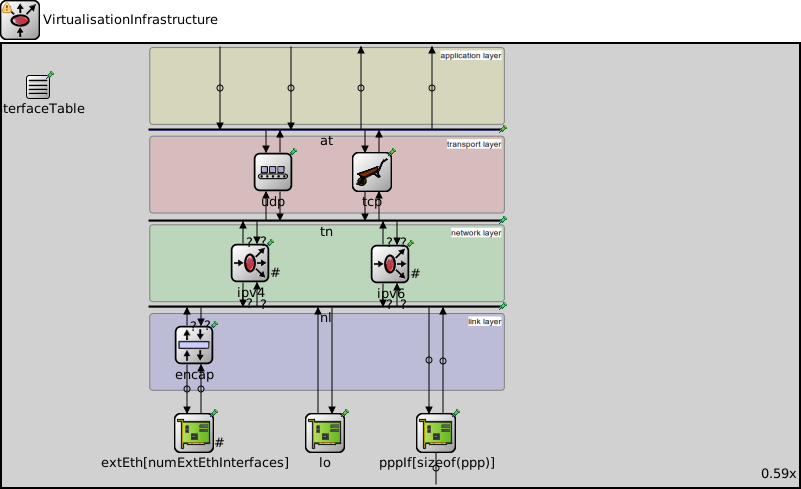
Usage diagram
The following diagram shows usage relationships between types. Unresolved types are missing from the diagram.
Used in compound modules
| Name | Type | Description |
|---|---|---|
| MecHost | compound module |
Represents a model of a Multi-access Edge Computing (MEC) host belonging to a MEC system, as specified by the ETSI GS MEC 003 specifications. It runs MEC applications within its VirtualisationInfrastructure and can provide a number of MEC services via the MEC platform. MEC applications can be created either dynamically by the MEC orchestrator or statically at the initialization of the simulation. The MEC host possesses a configurable number of computing resources (such as CPU speed, RAM, and storage) and keeps track of the utilization of these resources by the MEC applications via the VirtualisationInfrastructureManager. Moreover, this module includes a User Plane Function (UPF) that allows it to be connected with the 5G core network. |
Parameters
| Name | Type | Default value | Description |
|---|---|---|---|
| hasIpv4 | bool | true | |
| hasIpv6 | bool | false | |
| numIndependentMecApp | int | 0 | |
| numExtEthInterfaces | int | 0 | |
| gateway | string | "" |
Properties
| Name | Value | Description |
|---|---|---|
| networkNode | ||
| display | bgb=1350,750;i=block/dispatch |
Gates
| Name | Direction | Size | Description |
|---|---|---|---|
| ppp [ ] | inout |
Connection with GtpEndpoint and local/external networks |
|
| independentMecAppOut [ ] | output | numIndependentMecApp |
Connection to the ME App input gate |
| independentMecAppIn [ ] | input | numIndependentMecApp |
Connection to the ME App output gate |
| meAppOut [ ] | output |
Connection to the ME App input gate |
|
| meAppIn [ ] | input |
Connection to the ME App output gate |
|
| mecPlatform [ ] | inout |
Connection to the MEC Platform |
Unassigned submodule parameters
| Name | Type | Default value | Description |
|---|---|---|---|
| interfaceTable.displayStringTextFormat | string | "{numInterfaces} interfaces" |
Determines the text that is written on top of the submodule, supports displaying pars, watches, and module-specific information |
| interfaceTable.displayAddresses | bool | false |
Whether to display IP addresses on links |
| pppIf.pcapRecorder.displayStringTextFormat | string | "rec: %n pks" |
Determines the text that is written on top of the submodule, supports displaying pars, watches, and module-specific information |
| pppIf.pcapRecorder.verbose | bool | true |
Whether to log packets on the module output |
| pppIf.pcapRecorder.recordEmptyPackets | bool | true |
Specifies if zero length packets are recorded or not |
| pppIf.pcapRecorder.enableConvertingPackets | bool | true |
Specifies if converting packets to link type is allowed or not |
| pppIf.pcapRecorder.pcapFile | string | "" |
The PCAP file to be written, suggested value: pcapFile = "${resultdir}/${configname}-#${runnumber}" + fullpath() + ".pcap" |
| pppIf.pcapRecorder.fileFormat | string | "pcapng" | |
| pppIf.pcapRecorder.snaplen | int | 65535 |
Maximum number of bytes to record per packet |
| pppIf.pcapRecorder.timePrecision | int | 6 |
Time precision in recorded file. pcap supports only 6 (usec) or 9 (nanosec), pcapng supports more values (see 'if_tsresol' option in pcapng file format). |
| pppIf.pcapRecorder.dumpBadFrames | bool | true |
Enable dump of frames with hasBitError |
| pppIf.pcapRecorder.sendingSignalNames | string | "transmissionEnded" |
Space-separated list of outbound packet signals to subscribe to |
| pppIf.pcapRecorder.receivingSignalNames | string | "receptionEnded" |
Space-separated list of inbound packet signals to subscribe to |
| pppIf.pcapRecorder.dumpProtocols | string | "ethernetmac ppp ieee80211mac" |
Space-separated list of protocol names as defined in the Protocol class |
| pppIf.pcapRecorder.packetFilter | object | "*" |
Which packets are considered, matches all packets by default |
| pppIf.pcapRecorder.helpers | string | "" |
Usable PcapRecorder::IHelper helpers for accept packettype and store/convert packet as specified linktype currently available: "inet::AckingMacToEthernetPcapRecorderHelper" |
| pppIf.pcapRecorder.alwaysFlush | bool | false |
Flush the pcapFile after each write to ensure that all packets are captured in case of a crash |
| pppIf.ppp.displayStringTextFormat | string | "rate: %b\nsent: %s, rcvd: %r\nqueue: %q, drop: %d" |
Determines the text that is written on top of the submodule, supports displaying pars, watches, and module-specific information |
| pppIf.ppp.interfaceTableModule | string |
The path to the InterfaceTable module |
|
| pppIf.ppp.sendRawBytes | bool | false |
When true packets are serialized into a sequence of bytes before sending out |
| pppIf.ppp.mtu | int | 4470B | |
| pppIf.ppp.stopOperationExtraTime | double | -1s |
Extra time after lifecycle stop operation finished |
| pppIf.ppp.stopOperationTimeout | double | 2s |
Timeout value for lifecycle stop operation |
| extEth.bitrate | double | ||
| udp.displayStringTextFormat | string | "passed up: {numPassedUp} pks\nsent: {numSent} pks{udpDroppedText}" |
Determines the text that is written on top of the submodule, supports displaying pars, watches, and module-specific information |
| udp.interfaceTableModule | string |
The path to the InterfaceTable module |
|
| udp.checksumMode | string | "declared" | |
| udp.defaultMulticastLoop | bool | true | |
| tcp.displayStringTextFormat | string | "" |
Determines the text that is written on top of the submodule, supports displaying pars, watches, and module-specific information |
| tcp.checksumMode | string | "declared" | |
| tcp.advertisedWindow | int | 14 * this.mss |
In bytes, corresponds with the maximal receiver buffer capacity (Note: normally, NIC queues should be at least this size) |
| tcp.delayedAcksEnabled | bool | false |
Delayed ACK algorithm (RFC 1122) enabled/disabled |
| tcp.nagleEnabled | bool | true |
Nagle's algorithm (RFC 896) enabled/disabled |
| tcp.limitedTransmitEnabled | bool | false |
Limited Transmit algorithm (RFC 3042) enabled/disabled (can be used for TcpReno/TcpTahoe/TcpNewReno/TcpNoCongestionControl) |
| tcp.increasedIWEnabled | bool | false |
Increased Initial Window (RFC 3390) enabled/disabled |
| tcp.sackSupport | bool | false |
Selective Acknowledgment (RFC 2018, 2883, 3517) support (header option) (SACK will be enabled for a connection if both endpoints support it) |
| tcp.windowScalingSupport | bool | false |
Window Scale (RFC 1323) support (header option) (WS will be enabled for a connection if both endpoints support it) |
| tcp.windowScalingFactor | int | -1 |
Window Scaling Factor given as a shift count. Valid values are 0..14, and -1 for automatic selection (it chooses the smallest shift count that makes advertisedWindow representable in 16 bits) |
| tcp.timestampSupport | bool | false |
Timestamps (RFC 1323) support (header option) (TS will be enabled for a connection if both endpoints support it) |
| tcp.mss | int | 536 |
Maximum Segment Size (header option). Default 536 per RFC 1122. |
| tcp.msl | int | 120s |
Maximum Segment Lifetime |
| tcp.tcpAlgorithmClass | string | "TcpReno" | |
| tcp.dupthresh | int | 3 |
Used for TcpTahoe, TcpReno, and SACK (RFC 3517) DO NOT change unless you really know what you are doing |
| tcp.initialSsthresh | int | 0xFFFFFFFF |
Initial value for Slow Start threshold used in TahoeRenoFamily. The initial value of ssthresh SHOULD be set arbitrarily high (e.g., to the size of the largest possible advertised window) Without user interaction there is no limit... |
| tcp.stopOperationExtraTime | double | 0s |
Extra time after lifecycle stop operation finished |
| tcp.stopOperationTimeout | double | 2s |
Timeout value for lifecycle stop operation |
| tcp.ecnWillingness | bool | false |
True if willing to use ECN |
| tcp.dctcpGamma | double | 0.0625 |
A fixed estimation gain for calculating dctcp_alpha (RFC 8257 4.2) |
| tcp.pmtudEnabled | bool | false |
Path MTU Discovery (RFC 1191, RFC 1981) enabled/disabled |
| tcp.pmtudTimeout | double | 600s |
Time after which the original MSS is restored to probe for increased path MTU (RFC 1191, Section 6.3) |
| at.displayStringTextFormat | string | "processed {numProcessedPackets} pk ({processedTotalLength})" |
Determines the text that is written on top of the submodule, supports displaying pars, watches, and module-specific information |
| at.interfaceTableModule | string |
Module path to the InterfaceTable module |
|
| at.forwardServiceRegistration | bool | true | |
| at.forwardProtocolRegistration | bool | true | |
| at.interfaceMapping | object | {} |
Maps network interface names to connected submodule names (e.g. {"eth0": "bridging"}), overrides automatically learned dispatching; * overrides all learned network interfaces, ? overrides default |
| at.serviceMapping | object | {} |
Maps protocols to connected submodule names (e.g. {"ethernetmac": "bridging"}), overrides automatically learned dispatching; * overrides all learned services, ? overrides default |
| at.protocolMapping | object | {} |
Maps protocols to connected submodule names (e.g. {"ipv4": "bridging"}), overrides automatically learned dispatching; * overrides all learned protocols, ? overrides default |
| tn.displayStringTextFormat | string | "processed {numProcessedPackets} pk ({processedTotalLength})" |
Determines the text that is written on top of the submodule, supports displaying pars, watches, and module-specific information |
| tn.interfaceTableModule | string |
Module path to the InterfaceTable module |
|
| tn.forwardServiceRegistration | bool | true | |
| tn.forwardProtocolRegistration | bool | true | |
| tn.interfaceMapping | object | {} |
Maps network interface names to connected submodule names (e.g. {"eth0": "bridging"}), overrides automatically learned dispatching; * overrides all learned network interfaces, ? overrides default |
| tn.serviceMapping | object | {} |
Maps protocols to connected submodule names (e.g. {"ethernetmac": "bridging"}), overrides automatically learned dispatching; * overrides all learned services, ? overrides default |
| tn.protocolMapping | object | {} |
Maps protocols to connected submodule names (e.g. {"ipv4": "bridging"}), overrides automatically learned dispatching; * overrides all learned protocols, ? overrides default |
| nl.displayStringTextFormat | string | "processed {numProcessedPackets} pk ({processedTotalLength})" |
Determines the text that is written on top of the submodule, supports displaying pars, watches, and module-specific information |
| nl.interfaceTableModule | string |
Module path to the InterfaceTable module |
|
| nl.forwardServiceRegistration | bool | true | |
| nl.forwardProtocolRegistration | bool | true | |
| nl.interfaceMapping | object | {} |
Maps network interface names to connected submodule names (e.g. {"eth0": "bridging"}), overrides automatically learned dispatching; * overrides all learned network interfaces, ? overrides default |
| nl.serviceMapping | object | {} |
Maps protocols to connected submodule names (e.g. {"ethernetmac": "bridging"}), overrides automatically learned dispatching; * overrides all learned services, ? overrides default |
| nl.protocolMapping | object | {} |
Maps protocols to connected submodule names (e.g. {"ipv4": "bridging"}), overrides automatically learned dispatching; * overrides all learned protocols, ? overrides default |
Source code
//
// Represents the Virtualisation Infrastructure in a MEC host.
// It takes care of forwarding packets coming from the 5G core network to the
// appropriate MEC applications, applying the processing required by all the necessary
// network protocol layers.
// Optionally, it can host "independent" MEC applications, i.e., applications that
// are statically created at initialization, without going through the normal
// lifecycle (i.e., through the UALCMP and MEC orchestrator).
// It provides the external interface to communicate with emulated MEC applications,
// running outside the simulation environment.
//
module VirtualisationInfrastructure
{
    parameters:
        @networkNode();
        @display("bgb=1350,750;i=block/dispatch");
        @figure[applicationLayer](type=rectangle; pos=250,6; size=600,130; lineColor=#808080; cornerRadius=5; fillColor=#ffff00; fillOpacity=0.1);
        @figure[applicationLayer.title](type=text; pos=845,11; anchor=ne; text="application layer");
        @figure[transportLayer](type=rectangle; pos=250,156; size=600,130; fillColor=#ff0000; lineColor=#808080; cornerRadius=5; fillOpacity=0.1);
        @figure[transportLayer.title](type=text; pos=845,161; anchor=ne; text="transport layer");
        @figure[networkLayer](type=rectangle; pos=250,306; size=600,130; fillColor=#00ff00; lineColor=#808080; cornerRadius=5; fillOpacity=0.1);
        @figure[networkLayer.title](type=text; pos=845,311; anchor=ne; text="network layer");
        @figure[linkLayer](type=rectangle; pos=250,456; size=600,130; fillColor=#0000ff; lineColor=#808080; cornerRadius=5; fillOpacity=0.1);
        @figure[linkLayer.title](type=text; pos=845,461; anchor=ne; text="link layer");
        @figure[submodules];

        //# Network Layer specs
        bool hasIpv4 = default(true);
        bool hasIpv6 = default(false);
        *.interfaceTableModule = default(absPath(".interfaceTable"));
        *.routingTableModule = default("^.ipv4.routingTable");

        int numIndependentMecApp = default(0);
        int numExtEthInterfaces = default(0);
        string gateway = default("");

    gates:
        inout ppp[];				// Connection with GtpEndpoint and local/external networks

        output independentMecAppOut[numIndependentMecApp];			// Connection to the ME App input gate
        input independentMecAppIn[numIndependentMecApp];			// Connection to the ME App output gate

        output meAppOut[];			// Connection to the ME App input gate
        input meAppIn[];			// Connection to the ME App output gate

        inout mecPlatform[];			// Connection to the MEC Platform

    submodules:

        interfaceTable: InterfaceTable {
            @display("p=61,74;is=s");
        }

        //#
        //# link-layer modules
        //#
        pppIf[sizeof(ppp)]: PppInterface {
            @display("p=736,660");
        }

        // ethernet interface used for communicating with external applications in emulation mode
        extEth[numExtEthInterfaces]: <default("ExtLowerEthernetInterface")> like IEthernetInterface {
            parameters:
                @display("p=326,660,row,150;q=txQueue");
        }
        encap: <default("EthernetEncapsulation")> like IEthernetLayer if typename != "" {
            parameters:
                registerProtocol = true;
                @display("p=326,511");
        }

        lo: <default("LoopbackInterface")> like ILoopbackInterface {
            parameters:
                @display("p=548,660,row,150");
        }

        //#
        //# Network layer module
        //#
        ipv4: <default("Ipv4NetworkLayer")> like INetworkLayer if hasIpv4 {
            parameters:
                @display("p=420,372;q=queue");
        }
        ipv6: <default("Ipv6NetworkLayer")> like INetworkLayer if hasIpv6 {
            parameters:
                @display("p=657,374;q=queue");
        }

        //#
        //# Transport layer modules and corresponding application modules
        //#
        udp: Udp {
            @display("p=460,217");
        }

        tcp: Tcp {
            @display("p=627,217");
        }

        // message dispatcher for SAP between application and transport layer
        at: MessageDispatcher {
            parameters:
                @display("p=550,146;b=600,5,,,,1");
        }
        // message dispatcher for SAP between transport and network layer
        tn: MessageDispatcher {
            parameters:
                @display("p=550,300;b=600,5,,,,1");
        }
        // message dispatcher for SAP to link layer
        nl: MessageDispatcher {
            parameters:
                @display("p=550,446;b=600,5,,,,1");
        }

    connections allowunconnected:

        for i=0..numIndependentMecApp -1 {
            at.out++ --> independentMecAppOut++;
            at.in++ <-- independentMecAppIn++;
        }

        for i=0..sizeof(mecPlatform)-1 {
            at.out++ --> mecPlatform$o[i];
            at.in++ <-- mecPlatform$i[i];
        }

        //#
        //# App layer to transport layer connections
        //#
        at.out++ --> udp.appIn;
        at.in++ <-- udp.appOut;

        at.out++ --> tcp.appIn;
        at.in++ <-- tcp.appOut;


        //#
        //# Transport layer to network layer connections
        //#
        udp.ipOut --> tn.in++;
        udp.ipIn <-- tn.out++;

        tcp.ipOut --> tn.in++;
        tcp.ipIn <-- tn.out++;


        ipv4.ifIn <-- nl.out++ if hasIpv4;
        ipv4.ifOut --> nl.in++ if hasIpv4;

        ipv4.transportIn <-- tn.out++ if hasIpv4;
        ipv4.transportOut --> tn.in++ if hasIpv4;

        //#
        //# Network layer to link layer connections
        //#
        ipv6.ifIn <-- nl.out++ if hasIpv6;
        ipv6.ifOut --> nl.in++ if hasIpv6;

        ipv6.transportIn <-- tn.out++ if hasIpv6;
        ipv6.transportOut --> tn.in++ if hasIpv6;

        for i=0..sizeof(ppp)-1 {
            pppIf[i].upperLayerOut --> nl.in++;
            pppIf[i].upperLayerIn <-- nl.out++;
            pppIf[i].phys <--> ppp++;
        }

        for i=0..numExtEthInterfaces-1 {
            encap.lowerLayerOut --> extEth[i].upperLayerIn;
            encap.lowerLayerIn <-- extEth[i].upperLayerOut;
        }
        encap.upperLayerOut --> nl.in++ if numExtEthInterfaces != 0;
        encap.upperLayerIn <-- nl.out++ if numExtEthInterfaces != 0;

        nl.out++ --> lo.upperLayerIn;
        lo.upperLayerOut --> nl.in++;
}
File: src/simu5g/mec/vi/VirtualisationInfrastructure.ned
 This documentation is released under the Creative Commons license